During Pride Month, ACLU of Puerto Rico Renews Alert Over Legislative Threats to LGBTQ+ Rights
June 6, 2026 8:00 am
Spokesperson



Media Contact
San Juan, P.R. - The Puerto Rico Chapter of the American Civil Liberties Union (ACLU) warned of several active legislative measures that threaten or may threaten the rights of LGBTQ+ people in Puerto Rico, amid a growing federal and local offensive aimed at weakening or eliminating protections.
“From the ACLU of Puerto Rico, we will continue defending and advocating for the rights of LGBTQ+ people, particularly trans people, who are facing persecution that current federal and Puerto Rico government administrations seek to advance through actions that may even put people’s lives at risk,” said Annette Martínez Orabona, executive director of the ACLU of Puerto Rico.
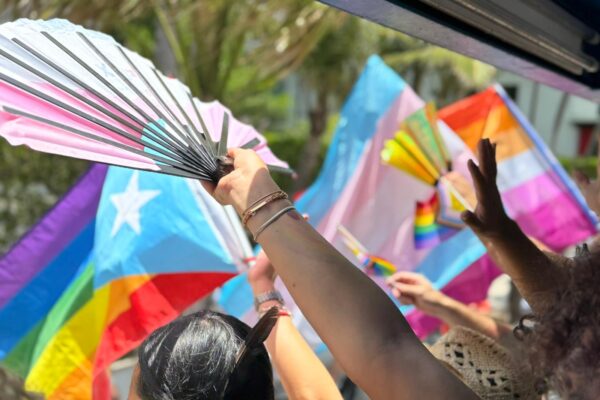
Ahead of the Pride march this Sunday, June 7, in San Juan, the organization called on the public not to take part in the campaign of disinformation and discrimination promoted by groups that distort facts and data to advance agendas that move away from the general welfare and the fundamental rights guaranteed by the Constitution of Puerto Rico for all people.
Currently, the ACLU is monitoring 530 legislative measures in the United States and our archipelago corresponding to the 2026 legislative session. The public can monitor the status of legislative measures impacting the rights of LGBTQ+ communities through our interactive map, which includes legislation introduced in the United States and Puerto Rico.
In our archipelago, since January 2025 alone, at least eight measures have been filed that threaten the rights of LGBTQ+ communities, three of which have become law. The five bills that remain active are:
- House Bill 166: The measure, authored by Representative Lisie Burgos Muñiz of Proyecto Dignidad, proposes establishing a discriminatory policy against trans women under the custody of the Department of Correction and Rehabilitation, particularly in the context of the Women’s Rehabilitation Complex. The bill seeks to exclude trans women from spaces that correspond to their gender identity, reinforcing unequal treatment of an incarcerated population that is already in a highly vulnerable situation. The measure opens the door to decisions based on prejudice rather than human rights standards. The bill remains active before the Committee on Women’s Affairs.
- House Bill 164: The measure, authored by Representative Lisie Burgos Muñiz and coauthored by eight representatives of the New Progressive Party (PNP), seeks to prohibit trans youth in public and private schools, as well as in public and private universities, from participating in sports teams that correspond to their gender identity. If approved, the bill would impose discriminatory exclusion on trans students, limiting their full participation in educational and athletic spaces and sending an institutional message of rejection toward a population that already faces high levels of stigma, violence, and vulnerability. The House of Representatives approved the measure on March 12, 2026. In the Senate, it has been referred to the Committee on Youth, Recreation and Sports.
- House Bill 162: House Bill 162, authored by Representative Lisie Burgos Muñiz, is part of the same offensive that produced Law 63-2025, but it remains a threat because it seeks to expand its effects. In addition to reinforcing the prohibition on hormone treatments, puberty blockers and surgeries for trans youth and gender-diverse people under 21 years old, the measure adds restrictions on official documents, health insurance coverage and the use of public funds. In practice, it would deepen medical, legal and administrative barriers against trans youth, their families and health care professionals. The bill remains referred to the Committees on Health and Judiciary.
- House Bill 185: House Bill 185, filed by Representative Jorge “Georgie” Navarro Suárez, would order Puerto Rico government agencies, instrumentalities and public corporations to use only the so-called “biological sex” in official documents and communications, and would prohibit any reference to gender identity. In practice, the measure seeks to administratively erase trans, nonbinary and gender-diverse people, denying recognition of their identities and exposing them to greater discrimination in their interactions with the State. The measure is before the Committee on Government.
- House Bill 912: House Bill 912, authored by Representative Lisie Burgos Muñiz, seeks to prohibit the use of inclusive language in documents issued by agencies, public corporations, municipalities, instrumentalities, dependencies, the Judicial Branch, the Legislative Branch and the University of Puerto Rico. More than a linguistic debate, the measure seeks to impose a public policy of symbolic exclusion that renders trans, nonbinary and gender-diverse people invisible in official State communications. The measure is before the Committee on Government.
Attention to Laws That Threaten Protections for LGBTQ+ People
Of the eight measures, the three that have become law are Senate Bill 350, now Law 63-2025; Senate Bill 1, now Law 14-2025; and House Bill 165, now Law 26-2026. The ACLU of Puerto Rico opposed these measures because it understands that they represent concrete threats to fundamental rights, open the door to discrimination, and particularly affect LGBTQ+ communities and other historically vulnerable populations.
In the case of Law 63-2025, the organization denounced that it criminalizes health care professionals and mothers, fathers and guardians by attempting to prohibit gender-affirming medical care for people under 21 years old, creating two distinct categories of children based on their gender identity. Regarding Law 14-2025, it warned that, although religious freedom is a fundamental right, its broad and unlimited application can be used as a subterfuge to deny services, access to justice and other civil rights. Likewise, the ACLU of Puerto Rico opposed Law 26-2026, signed by the governor on February 25, which imposes discriminatory restrictions in public spaces and prohibits the installation of inclusive, mixed or gender-neutral bathrooms in agencies, dependencies, instrumentalities, public corporations, the University of Puerto Rico and municipalities.
“The fact that these measures have become law does not mean that we are not vigilant about their implementation or that affected people cannot claim their rights. We remain attentive to the various scenarios in which the enforcement of these laws operates or may operate in a discriminatory manner against LGBTQ+ people,” noted Lolimar Escudero Rodríguez, public policy attorney at the ACLU of Puerto Rico.
Awaiting Rulings in Federal Court
At the federal level, the ACLU of Puerto Rico appeared in April as a friend of the court before the U.S. Court of Appeals for the First Circuit, in Boston, to defend the right of nonbinary people to obtain birth certificates that accurately reflect their gender identity, in the case Ínaru Nadia de la Fuente Díaz v. Jenniffer A. González Colón.
In this controversy, the government of Puerto Rico seeks to reverse the determination of the U.S. District Court for the District of Puerto Rico, which concluded that the current policy of the Commonwealth violates the right to equal protection of the laws by preventing nonbinary people from obtaining an “X” gender marker on their birth certificates.
The ACLU is also awaiting the determination of the U.S. Supreme Court in West Virginia v. Becky Pepper-Jackson, a trans girl represented by the organization alongside Lambda Legal and Cooley LLP. This case is important not only because of the categorical exclusion of transgender girls and women from girls’ and women’s teams in violation of the Equal Protection Clause and Title IX. Here, the Court could issue a much broader ruling that allows discrimination in other contexts and against other communities.
That is why, even though the number of trans students in athletics is small, restricting their freedom to play has become a central objective for politicians seeking to push transgender people completely out of public life. The hope of those who oppose equality is that a Supreme Court ruling against the rights of young people like Becky will allow them to discriminate against transgender people in various contexts.
Through litigation, lobbying, public education and organizing, the ACLU works to build a country where our communities can live openly without discrimination and enjoy equal rights, personal autonomy, and freedom of expression and association.
Related Content

Ínaru de la Fuente Díaz v. Jenniffer González Colón et al. - Amicus ACLU F. & ACLUPR

ACLU Foundation and ACLU of Puerto Rico file amicus brief in the First Circuit to defend the right of nonbinary people to accurate identity documents
Stay Informed
Sign up to be the first to hear about how to take action.
By completing this form, I agree to receive occasional emails per the terms of the ACLU’s privacy statement.
By completing this form, I agree to receive occasional emails per the terms of the ACLU’s privacy statement.