
ACLUPR Confirms Administrative Subpoena: DTOP Secretary Cooperated Without Objection with ICE’s “Fishing Expedition” Targeting Immigrants
October 15, 2026 1:30 pm
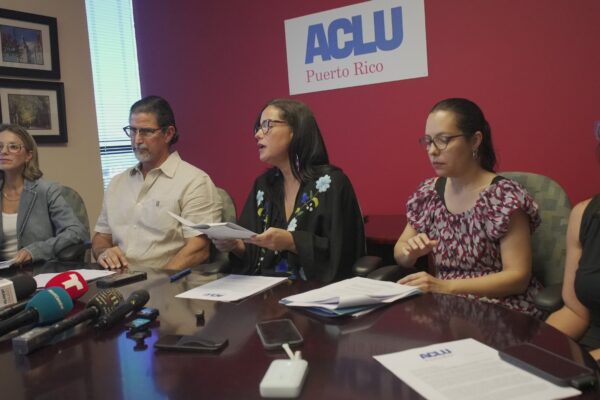
Spokesperson



Media Contact
San Juan, P.R. – The American Civil Liberties Union of Puerto Rico (ACLUPR or ACLU of Puerto Rico) called for the resignation of Department of Transportation and Public Works (DTOP) Secretary Edwin González Montalvo after confirming that the agency cooperated with a “fishing expedition” by federal immigration authorities by voluntarily turning over confidential information on approximately 6,321 immigrants who hold driver's licenses in Puerto Rico.
"The DTOP secretary has a ministerial duty to uphold and to comply with local laws and the protections established in our Constitution. Through his actions -not only voluntary turning over confidential information to ICE, but also refusing to release information that would allow the people of Puerto Rico to know the truth-, the secretary demonstrated his inability to assume the responsibilities of his office and fulfill his constitutional mandate”, said attorney Annette Martínez Orabona, executive director of the ACLU of Puerto Rico.
ACLUPR’s position come after the Puerto Rico Supreme Court issued a “denied” ruling on DTOP’s second motion for reconsideration, its latest attempt to overturn the lower court’s rulings that found the administrative subpoena that led to the voluntary disclosure of data in thousands of immigrants to U.S. Immigration and Customs Enforcement (ICE) to be a public document. The Court issued its ruling on October 9, 2026, although it was notified on October 14, 2026. Following the issuance of the notice, DTOP turned over the information to ACLUPR.
“With this decision by the Puerto Rico Supreme Court, we celebrate the protection of the right to know that we all share. However, the time that has elapsed is itself a violation of the fundamental right to know the truth about what happened and to understand that the tragedy experienced by thousands of migrants and Puerto Rican families had an ally in the Government of Puerto Rico,” said Martínez Orabona.
What Does the Administrative Subpoena Say, and How Was the Information Disclosed?
The administrative subpoena was issued by the Department of Homeland Security (DHS) on January 26, 2025, and addressed to the Directoría de Servicios al Conductor (DISCO) (Department of Motor Vehicles). An analysis of the document indicates that the Department of Transportation and Public Works (DTOP) was under no legal obligation to respond to the request by providing the requested information.
Instead, the proper course of action would have been to require a court order specifying the information or data the agency was required to produce, if such an order were issued. DHS stated in its request that DISCO, which operates under DTOP, had until February 7 to respond. DTOP, however, took only three days to voluntary produce and turn over the confidential information of thousands of immigrants. The document containing this information is dated January 29, 2025. DTOP specifically provided the following data on immigrants holding driver’s licenses in Puerto Rico:
- Identification number issued by DTOP
- Type of identification issued by DTOP (driver’s license)
- Date the identification was issued
- Expiration date of the identification
- Applicant’s identification number
- Applicant’s first name
- Applicants middle name
- Applicants’s paternal surname
- Applicant’s maternal surname
- Applicant’s date of birth
- Applicant’s citizenship, where abbreviation EMI for Estado Migratorio Indefinido (Undetermined Immigration Status).
- Applicant’s residential address information
- Applicant’s municipality and Zip code
- Applicant’s telephone number
As the ACLU of Puerto Rico had anticipated, the contents of the administrative subpoena itself confirm that the request was always a “fishing expedition,” with which the administration of Governor Jennifer González Colón cooperated without objection through DTOP Secretary and engineer Edwin González Montalvo, as well as Secretary of Justice Lourdes L. Gómez Torres, who had no qualms about allocating resources to obstruct access to public information for more than a year. In its request, DHS referred to an “ongoing investigation” conducted through its Homeland Security Investigations (HIS) division. DHS listed the categories of information requested, covering the entire population of individuals with regular immigration status,” and DTOP agreed to provide the information.
DTOP and the Department of Justice Obstructed the Release of Information for More Than a Year
The ACLU of Puerto Rico filed a lawsuit on October 1, 2025, after the DTOP secretary refused to comply with the organization’s public records request seeking to learn how the agency handled and responded to ICE’s request to the state agency. Following a hearing on the parties’ arguments, the Court of First Instance ordered DTOP to release the administrative subpoena, concluding that the document was public. The agency failed to comply with the order and instead appealed to the Court of Appeals, which upheld the Court’s ruling in January 2026. DTOP then took the case to the highest judicial forum, the Puerto Rico Supreme Court.
The Puerto Rico Supreme Court initially denied DTOP’s petition for certiorari on April 27. DTOP Secretary Edwin González Montalvo, represented by the Department of Justice, then filed a motion for reconsideration, which was considered by a three-justice panel composed of Chief Justice Maite Oronoz Rodríguez and Associate Justices Erick Kothoff Caraballo and Ángel Colón Pérez. The second “denied” ruling was issued on June 5, after which the agency filed its second motion for reconsideration. The Supreme Court’s three rulings in this case were issued by different justices, suggesting a unanimous determination reflecting the views of all nine justices on the Court.
“The Puerto Rico governments ‘disgraceful cooperation with the Trump administration’s inhumane immigration policies not only demonstrate a complete lack of empathy and sensitivity towards our immigrant communities but also lays bare its complicity in the systematic violation of this vulnerable population’s civil and human rights, “said attorney Fermín Arraiza Navas, legal director of the ACLUPR.
By turning over the information to ICE, the DTOP secretary jeopardized the safety of thousands of immigrants who placed their trust in the Government of Puerto Rico when, in 2013, a process was established under Law 97 to allow them to obtain a driver’s license while protecting information about their immigration status.
The law established that the registry of immigrants holding driver’s licenses was intended to compile “official statistics of the Commonwealth of Puerto Rico.” It also stipulated that the necessary administrative mechanism would be established to ensure that the registry would not be used to discriminatory purposes or that the information in the agency’s possession.”
You can find more details about the case at this link.
It is worth noting that the actions taken by the DTOP secretary differ from the safeguards established in other U.S jurisdictions. For example, in Virginia, the Department of Motor Vehicles (DMV) explicitly states that it cannot release protected driver and personal information for civil immigration enforcement unless the individual consents or the requesting agency presents a lawful judicial order, judicial subpoena or judicial warrant. The Virginia DMV is required to deny requests that do not meet the statutory requirements.
Similarly, the Illinois’ Vehicle Code provides that the Secretary of State may not release or otherwise make accessible highly restricted personal information or personally identifying information to an immigration agent unless doing so is necessary to comply with a lawful court order, a judicial warrant signed by an Article III judge or a subpoena for individual records issued by a federal or State court.
In New York, the New York’s Driver’s License Access and Privacy Act, as it has been amended, prohibit the DMV from sharing driver license or related personal information with immigration enforcement agencies like ICE without a judicial warrant, or court order.3 Likewise, the statute states that if the immigration enforcement agencies request DMV data, the DMV must notify the license holder.
Documents
Related Issues
Related Content

ACLU of PR v. DTOP

Supreme Court rejects DTOP petition: order to disclose subpoena on immigrant data remains in effect
Supreme Court Again Denies DTOP’s Attempt to Keep Subpoena on Immigrants Hidden

Court of Appeals orders DTOP to disclose subpoena regarding the handover of information on thousands of immigrants
Stay Informed
Sign up to be the first to hear about how to take action.
By completing this form, I agree to receive occasional emails per the terms of the ACLU’s privacy statement.
By completing this form, I agree to receive occasional emails per the terms of the ACLU’s privacy statement.